Snow on peaks

Snow on peaks

Wednesday, February 13, 2013

FireLight- an Exhibition

The Mexican Consolate of Dallas has given me this wonderful opportunity to show my work:

                         The Mexican Consulate Presents: 


"The FireLight" Series
Photographs by Kitty Alice Snead
February-May 2013
Opening Reception:
Wednesday, February 20, 2013
6:30-8:30 pm
1210 River Bend Dr.
Dallas, TX 75247

The Raramuri people know a secret: the essence of life. In order to preserve it, they rarely ever grant access to outsiders into their world.
I am no stranger- I am "adopted family". That's why I share their universe with you through a ceremony rarely photographed at night: FireLight.
Share with us authentic food, drinks and the Raramuri Culture through photographs, folk art, textiles, & video.


Wednesday, April 11, 2012

Tarahumara Blanket Weaving

Maria Elena
In the early spring of 2008 I video taped a traditional Tarahumara blanket weaver at work. On March 26, 2012 I showed my video, “Tarahumara Blanket Weaving,” as well as the blanket itself and photography stills to the Dallas Area Fiber ARTists. The video documents the work of a traditional Tarahumara blanket weaver. Blanket weaving is in rapid decline among the Tarahumara due to the introduction of cheaper, imported blankets from China.

Beginning with the hand shearing of a sheep with common kitchen scissors, this video follows a Tarahumara woman through all the steps and processes of creating a hand-woven blanket and ends with her working the giant ground loom. The goal of the video is to document the traditional processes and to instill in the viewer an appreciation for the ancient craft of weaving.

Mexico's Tarahumara are one of three indigenous groups still maintaining their own traditional lifestyle by living in remote areas of the Copper Canyon located in the State of Chihuahua, Mexico. They are one of the designated National Treasures of Mexico. My talk detailed personal experiences with the weaver, Maria Elena, and my own necessary use of the massive blankets while traveling and camping in the high country of the Sierras Madre Tarahumara.


This link takes you to Maria Elena's demonstration of traditional blanket weaving among the Tarahumara (Raramuri):  Traditional blanket weaving


Wednesday, February 1, 2012

Fires of the Tarahumara

"To the Circle of Fire;
those who have gone before,
those who are present,
and those who have yet to come."
From The Four Agreements
by Don Miguel Ruiz


Fire, one of the ancient world's five elements, can be heard, seen and felt.
And the ancient world is yet present here among us humans, in a great gathering, a celebration of the autumnal harvest season.
As darkness falls, the night air is clear, crisp and filled with anticipation.
Then comes Fire, drawing the community near for warmth and companionship;
Fire, illuminator of the night, quells fears shrouded in the darkness.
This night reflection of the fire is found in the hearts of "the People".
The flames & passion ignite the ecstasy of the dance.
Listen now through the veil of time.  Hear low voices speaking an ancient tongue, the cries and delight of children, the rolling laughter of the "the People" echoing out across the land on this night.

Yes, Miguel, Again!

"To the Circle of Fire;
those who have gone before,
those who are present,
and those who have yet to come."

This image is a distillation of a Tarahumara ritual celebration and a gift to me that I share with you- the viewer.

Wednesday, January 25, 2012

Haley-Henman Gallery Exhibit

The Haley-Henman Gallery Features
 Five Photographers

Kitty Alice Snead
David Clanton                 Lee Albert Hill
Alan Robertson               Brett Schneider


February 4-25, 2012
Opening Reception is Saturday, February 4 from 6:00 to 9:00 pm

The Haley-Henman Gallery is located at 2335 Hardwick Street Dallas, TX 75208
Gallery hours: Wednesday-Saturday, 12 noon to 5:00 pm and by appointment.
For appointment call: (214)749-1277
Contact person: John Marcucci, Gallery Director

The exhibition: Five Photographers, features the work by Kitty Alice Snead, David Clanton, Lee Albert Hill, Alan Robertson, and Brett Schneider. These photographers bring forth their individual talent and expertise in different ways.

Kitty Alice Snead began "Fire Light" in 2007 after establishing a rapport for ten years with the Tarahumara people of Northwestern Mexico.  These photographs occur on a moonless, spring night during their ritual celebration of Tutu Bur/Yumari. Using only the light from campfires and a fireball lantern, Ms. Snead moved about the dance and the women's circle all night long. From this extraordinary collection, the gallery presents a premier selection of six photographs.

David Clanton's images are the melding of disparate elements of metallic textures, reflecting surfaces of color, or facets of stone. His abstractions derive from eight or more layers of underlying images that boldly create balance, harmony and dimensionality that speak to our urban surfaces as a quality in need of discovery.

Lee Albert Hill presents works from his "Signal Series".  Using the theme of maritime signal flags used for visual communication between ships at sea and mid-20th century junk cars in the middle of West Texas, these composite photographs ask questions about our unsustainable past and how we move on to a new, sustainable future.

Alan Robertson's inspiration for his "Illumination Series" comes from George Eastman, who said, "Light makes photography. Embrace light. Admire it. Love it." In these new works, Mr. Robertson is drawn to the interplay between natural and enhanced light, particularly light fixtures and patterns of illumination.  How these patterns will change with new lighting technology is poignantly highlighted in the way Mr. Robertson points the lens to the grandeur of the architectural past.

Brett Schneider captures Texas landscapes emphasizing the power between sky and land. This relationship highlights the extremes in temperature and mood and adds to the speculation of how Texans are shaped by these extremes in the landscape.


Wednesday, September 21, 2011

Tarahumara Mask Maker


Simon Morales, the mask maker
 Yesterday we left in the "burro negro" (the black van) and headed out the way we came in towards La Bandera to look for Simon Morales, the old mask maker. We stopped a Tarahumara woman herding her goats to ask for Simon's place. She indicated we needed to go back a bit. He was down a hill off the road.
We found the place, going down a steep incline. There appeared to be no one home, the 1st house was closed up tight. Beyond a cornfield was a  larger house with raised grain storage huts and animal pens. Both compounds had pens and were behind rock walls about 4 feet tall.  We could see a young woman stirring around outside the far compound.
As we passed the 1st smaller compound I could see "animalitos", or small toys on the window sill and I said to Beto, "this is Simon's place".

Beto at Simon's

When we approached the woman, Santiago asked if she knew Simon.  She indicated the 1st adobe home was his but he was not home. We headed back for the "burro negro" at the top of the hill.  It is steep and I struggled, pulling for air stopping to rest several times before I got to the top.  We climbed in the van and headed back to Nararachi.  It seems Simon has two homes with the 2nd located up on the mesa behind the church and towards the air strip.
The nurse, Marta, in the clinic told me before we left that Simon was probably at his home closer to Clause's place as he (Simon) had been especially invited to the party for the community. I asked if she'd seen Simon at the party and she said no, but there were a lot of people there!
As we headed back I looked to my right and saw an old man carrying a korima pail headed in the direction of Simon's.  I said "stop, that's him!" Santiago wanted to argue but Samuel stopped and got out and asked the man on the path if he were Simon. Yes, indeed it was him!
That was Christmas day miracle #1.
Beto and Santiago walked with the old man back to his home. I rode the van to the top of the "killer" hill with Samuel and walked down to Simon's for the second time.
We entered his home and visited with Simon. As the old man is deaf it was hard to make him understand we were interested in watching him make a mask.  But we did get the idea over to him that we wanted to buy two or three.
I began to ask if he had the wood to make one.  Santiago being passive. The old man said he'd have to go down to the arroyo to get the wood-- madrono.  The arroyo was not far so we asked to go with him to watch him get the wood for the mask.
Simon got his ax and off we went past the second compound, down into a ravine and up an incline. Simon knew where a large madrono was and he chopped a slab or chunk out, about 10" to 16" and we started back.
Miracle of Christmas day #2: watching a mask being made from tree to finish. I photographed his tools around the slab of wood that would beome my mask while Simon and the other men drank coffee and visited. We made arrangements to go back the next day (today) about 9-9:30 am.


 When we got to Simon's today he was seated outside his wall on a log, hard at work. He had already shaped the mask and begun the process of digging out the backside. I took digital shots of the process and made a video with the little Sony digital camera.
Simon's outdoor workshop has a view out across the field to the mountains and ravines beyond. Gorgeous!
The goats came to visit and graze on the corn stalk stubs and old cobs.
We broke for lunch at 12:45. We'd brought the pinic of saltines and portales (sardines), orange soda, jalapeno condiments, some serious cheese, and cookies.

The mask needed only finish work as the old man resumed.  His arm began to ache and we said "let's stop for the day". Simon agreed.  We'll pick up two masks-- mine and Beto's on Friday around 2 p.m.
Before I left I took a black and white protrait of Simon-- he was tired.  I'll try to do another on Friday.
I climbed the hill again and pulled for air.  It's a serious climb for me.
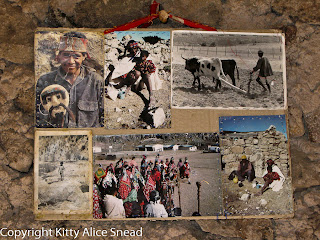
Aside: There were snapshots on Simon's wall, one of a young man holding a mask. That turned out to be his son, Felipe who now lives and works in Cuauhtemoc in agriculture.
I asked when Simon started making masks.  He said he couldn't remember-- a long time ago.  Clause had got him started.
He pulled out his ID card, Simon is officially 70 years old!

Simon wearing the finished mask


Wednesday, June 1, 2011

The Firelight Series


As a girl I spent summers in the Mellon Gallery looking at the old, forgotten world of the “Dutch Masters.” I suppose I carry the memory of their use of light --candle light-- with me. Later in my travels I would find that same light again.


I began photographing the Tarahumara people of Northwestern Mexico in 1998 and continued to do so for ten years. I was drawn to their traditional way of living. Today, as in ancient times, their customs are passed down through oral tradition and in their own language, Raramuri. Living in remote areas of the Sierras the Tarahumara have kept their sense of community through a rich and colorful ritual life. The use of ritual marks and celebrates the passing of the seasons, which are so important in their agrarian lives.


Fire Light was begun in 2007 during a Tutu Buri/Yumari celebration on a moonless, spring night out in the Mexican Sierras. I did not want to use a flash but the night was pitch-black except for scattered warming fires at the edge of the dance circle. I whined disappointedly at the lack of light. A fire was built for me just behind the Chapeyokos so that I could photograph their use of the mask. This was a project that I had begun for The Journal of the SouthWest out of the University of Arizona at Tucson.

I liked the tone captured by the camera in the firelight located so close to the Chapeyoko figures –mysterious larger than life images of masked figures. This series had the look and feel of the ritual I had experienced so many times before. The vexing question had always been, ‘how to move the fire around with me?’ My guide Santiago and I discussed this at length when it suddenly dawned on us to use the lanterns from the ball race to light the ritual of the dance. This would give me the mobility I so desperately wanted.


Two years later I was again in the highlands for the Mate chine dance and Tutu Buri/ Yumari. Santiago packed in two modified ball lanterns for us. The people camped overnight in the village dancing, cooking and drinking throughout the night of Dec. 11th. The dancing continued into the morning of the 12th then the food was passed out to feed the community. Along with video footage, I shot the remainder of The Fire Light Series. Two or three days later another Tutu Buri/ Yumari took place in honor of a Tarahumara woman who had recently passed away. So I was able to photograph these night dances using fire as my light source. Many of the images were made possible by the ball lanterns we used.


The Fire Light Series moves beyond documentation. It has the look and feel of the night—ritual acts, campfires, and celebration. Besides recording the dance I wanted to show the women’s involvement –the strong sense of community and tradition. Working in the back country for 10 years I had been to many such gatherings and felt relatively comfortable around the laughter, drinking, and carousing that goes on during breaks in the dancing. It’s not for everyone but I liked the challenge and the camaraderie.


And the Tarahumara grew accustomed to my presence. When we lit the lanterns they laughed and asked if we were going to run a race! The lanterns were familiar and unobtrusive. Success!


What began as an interest in “Native American “culture continued out of my growing respect for a people, who in the face of overwhelming odds continue to live their lives outside the mainstream comforts of the modern world. These people retain the skills and knowledge to survive in harsh conditions. My own culture has largely lost the sense of community. The community organization entrusted with governing and maintaining tradition also supports the individual in times of need. In short our families and communities are disunited. As individuals we no longer possess the skills to feed ourselves.

As with Gilpin, the guide is the key into a hidden culture. Her friend was the reservation nurse. Mine is a rascal who walks the canyons and knows the trails and customs. Santiago is well known and respected with many friends and connections in the World of the Tarahumara. This work would have been impossible without him. And then I have to acknowledge another guide, Tim Boole, a talented photographer who has worked and taught Photoshop to photographers since its introduction. In the beginning, the New Mexican photographer Douglas Hall, taught me to see –to visualize a body of work and then move the concept through the necessary choices to produce the final image on the wall.

If you have time, this link shows a video of  similar ritual celebrations. Tarahumara Ceremonies


Wednesday, April 27, 2011

Santiago and the Devil's Crosses


Santiago and Beto

On Thursday, Dec. 12th when the dancing was done and most of the barbacoa had been eaten and the tesguino drinking was in full tilt, the Anglos lay in the shade of the hut sleeping and trying recover from being up all night and too much coffee and then tesguino.

The Alter
The Alter was still in the patio--that is the structure remained. The sacrificial bowls of meat had been removed much earlier and the cooked goat meat added to the beans. The copal incense bowl still lay centered under the altar. And the small crosses in the dirt at the rear of the alter along with the miniature offering bowls remained, but the cloth had been removed along with the decorative beads leaving only the wooden frame and the ritual objects on the ground.


Earlier in the evening on Wednesday Santiago had told me that the small crosses and tiny offering bowls on the ground were the Devil’s offerings (Give the Devil his Due). The devil could also eat without coming up to cause mischief or harm one of the humans.

At any rate Santiago late in the evening on Thursday told me he was going to ask for permission to take the “Devil’s Crosses”. There would be one for me, Beto and himself. Early Friday morning I was in the capella dressing and I heard Santiago ask for the crosses. (I could not see so I do not know who he asked but one of  the “important” elders). I could hear the response, in Spanish, which I understand as a polite but firm, NO! The responder explained that it would not be proper to take the Devil’s crosses because it could go badly for us. To take a cross might cause us bad luck on our travel home—something bad might happen to us.

Nabor ready to leave

Given the reason; I no longer wanted one of the small crosses.